Diamond Shine Blogs
Why Brake Dust Won't Wash Off Your Wheels
You wash the car, the paint comes up clean, and the wheels still look filthy. There's a grey-brown film across the face of each one, heavier behind the spokes, and no amount of soap and a wash mitt seems to touch it. If anything, the wheels look worse a week later than the paint does after a month.
That's brake dust, and it doesn't behave like ordinary road grime. Washing it the way you wash the rest of the car is why it never comes off.
Brake dust isn't dirt sitting on the surface
Every time you brake, the pads grind against the rotors and throw off a mix of metallic particles and adhesive binder. Those particles leave the rotor hot and land on a wheel that's also hot, and they partly fuse to the finish instead of resting on top of it. The longer they sit, the more they corrode and bond down.
So a wash mitt full of car soap is sliding over the top of something that's physically stuck. You need three things soap alone can't give you: contact time, mechanical agitation that reaches into the places a mitt can't, and — on bare metal — something that addresses the oxidation underneath.
Never clean a hot wheel
This is the step people skip, and it's the one that causes damage. If you've just driven, the wheels and rotors are hot. Anything you spray on a hot wheel flashes off before it can do any work, and it can dry into the finish and leave marks you'll have to polish out later.
Park in the shade and give the wheels fifteen or twenty minutes. Touch the face of one with the back of your hand — if it's warm, wait longer. Cold wheel, cold water, then start.
Rinse first, then let the product sit
Hit each wheel with a strong rinse first. That knocks off the loose grit a brush would otherwise drag across the finish — which is how most wheel scratches actually happen. Not from the brush, but from the sand the brush is pushing around.
Then apply your cleaner and leave it alone. Most people spray and immediately start scrubbing, which wastes the part of the process doing the real work. Give it the dwell time on the label while you move to the next wheel, then come back and agitate. Work one wheel at a time so nothing dries on the surface.
Match the brush to the finish
Wheel faces are the easy part. The barrels, the backs of the spokes and the wheel wells are where brake dust actually piles up, and they're almost impossible to reach by hand — which is why detailers reach for a drill.
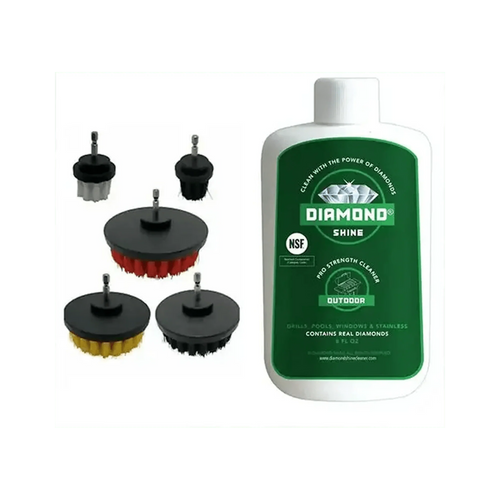
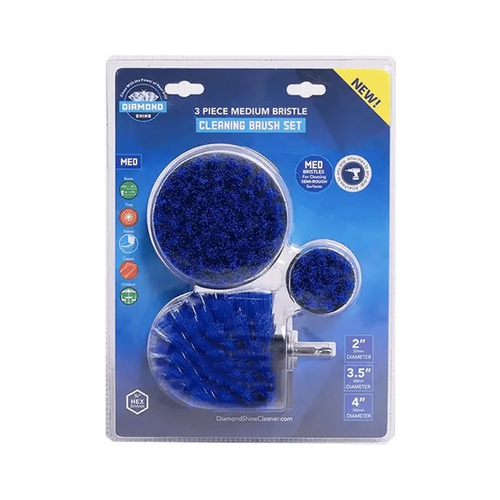
For painted and clear-coated alloy wheels, stay soft. The 3-pack soft bristle drill brush set is built for exactly this: scratch-free scrubbing on delicate surfaces, wheel wells included. The 2" detail brush gets between spokes and around lug nut recesses, the 3.5" dome follows the curve of the barrel, and the 4" flat covers the face. They fit any drill with a standard 1/4" quick-connect shaft.
Save the medium bristle set for the wheel wells and tire sidewalls, where the surface is rubber and plastic liner rather than a finish you can mar. Run the drill at a moderate speed with light pressure — let the rotation do the work, not your arm. And whichever brush you use, test it on a hidden spot first, the back of a spoke or the inside of the barrel.
If you're only buying one thing, the car detailing drill brush and microfiber towel set pairs the brushes with a large towel for drying. The drill itself isn't included in any of these sets.
Chrome and polished aluminum need a different approach
Bare metal wheels and trim are a separate job. Once brake dust has sat on chrome or polished aluminum, what you're looking at isn't only dust — it's oxidation and, often, the beginning of rust pitting. Scrubbing that with a brush won't fix it, because the problem is in the metal, not on it.
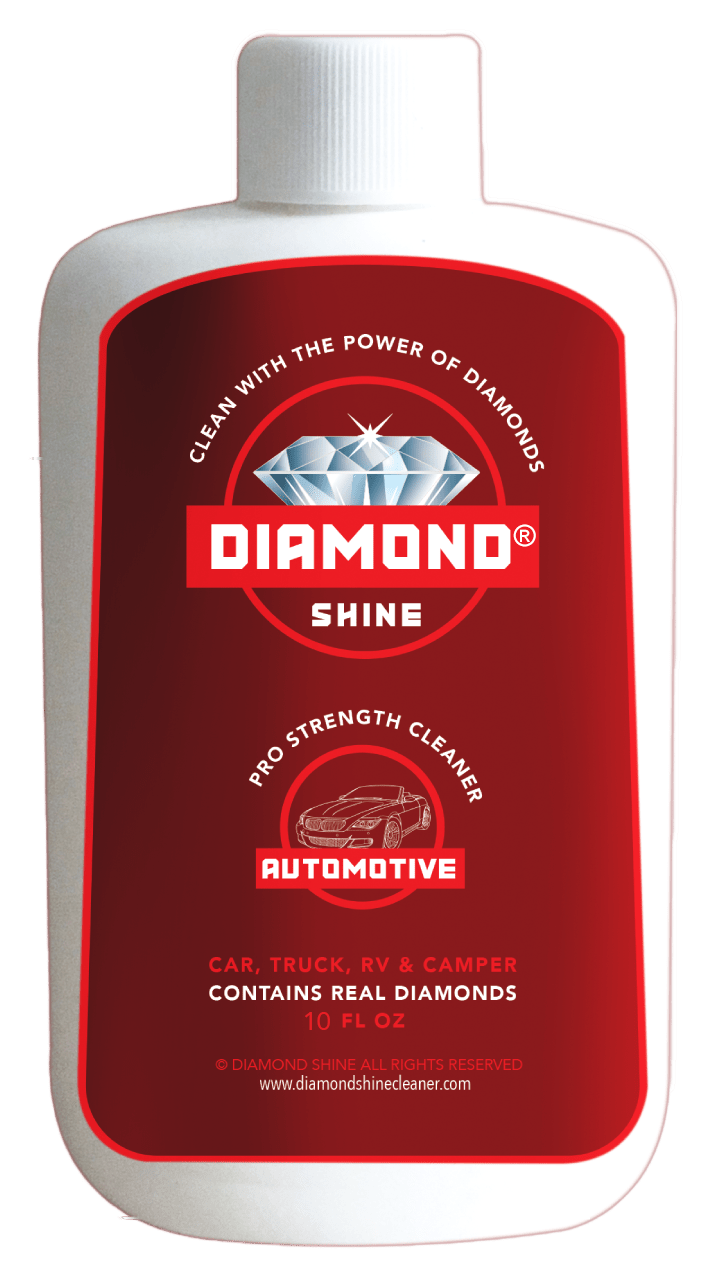
Diamond Shine Automotive Cleaner is formulated for that: it removes rust from chrome and polishes metal back to a high-gloss finish on chrome, aluminum, stainless steel, silver, gold and copper. It's applied differently from a spray cleaner — a few drops onto a microfiber applicator pad or a white scrub pad, worked gently into the surface rather than sprayed across the whole wheel. That same bottle handles the water spots on your windshield, which is the other thing that survives a normal wash.
Dry them; don't let them air dry
If you rinse and walk away, the water evaporates and leaves its mineral content behind as spotting — and you've just undone a chunk of the work. Dry each wheel before moving on.
A large, high-absorbency towel makes this fast. The Ultra Premium Auto Detailing Towel is 36x27 at 800 GSM with banded edges so it won't scratch paint, which is what you want on wheels and on the panels above them.
How to make next time easier
Brake dust is cumulative. A wheel cleaned every couple of weeks takes five minutes; one left for a season takes an afternoon and may never fully recover, because the particles have had months to corrode into the finish. The single highest-value habit is simply not letting it build.
If you're setting up to do this properly, the Car Detailing Pro Bundle puts the automotive cleaner, the drill brush and microfiber set, and the cleaning gel for interior vents and crevices together in one kit.
The short version
Let the wheels cool. Rinse before you touch them. Give the cleaner its dwell time instead of more muscle. Use a soft brush on coated alloy and step up only where the surface allows it. Treat bare chrome and aluminum as a polishing job, not a scrubbing one. And dry everything before the water dries itself.