Diamond Shine Blogs
Why Hosing Off Your Patio Doesn't Work
Your patio looks great for four minutes. You drag the hose out, blast the slab, and while it is wet the concrete is the color it is supposed to be. Then it dries and the same gray-green dinginess comes back, along with orange rings where the chairs sit and a chalky white bloom at the base of the brick.
Nothing was wrong with your effort. Hosing concrete mostly just rearranges water. Here is what is actually happening, and what gets a slab clean enough to stay that way.
Concrete is a sponge, not a surface
Glass and stainless steel are closed surfaces. Soil sits on top and a wipe takes it off. Concrete, brick, stucco and mortar are porous. Dust, pollen, algae film and tire grime settle down into thousands of tiny open pores, and water from a hose runs across the top without ever reaching them.
That is exactly why the slab looks clean wet and dirty dry. Water fills the pores and darkens everything evenly; once it evaporates, the grime that was never removed is visible again. Getting it out takes two things a hose cannot provide: a cleaner left in contact long enough to loosen the deposit, and mechanical agitation to lift it out of the pores.
Three stains that look similar and are not
Most patios have more than one problem at once, and treating all of it the same way is why people conclude concrete just looks like that.
General gray film is organic. Dust, pollen, algae and leaf tannins. It responds to ordinary detergent plus scrubbing. No special chemistry required; it simply needs agitation that reaches into the pores instead of skating over them.
Orange or brown rings under furniture feet, planters and grill legs are rust that bled out of metal and soaked into the concrete. Soap will not touch it, and scrubbing harder only burnishes the stain. Rust has to be dissolved.
Chalky white patches on brick, block and newer concrete are usually efflorescence: mineral salts carried to the surface by moisture moving through the masonry and left behind when that moisture evaporates. People reach for bleach because it looks like mildew. It is not mildew, and bleach does nothing to it. Like hard water scale on a shower door, it is a mineral deposit, and it has to be dissolved and brushed away.
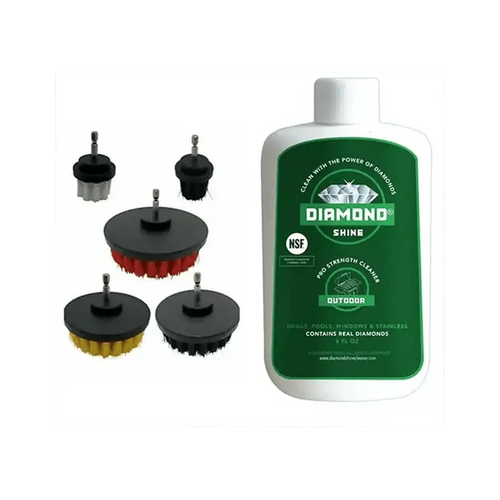
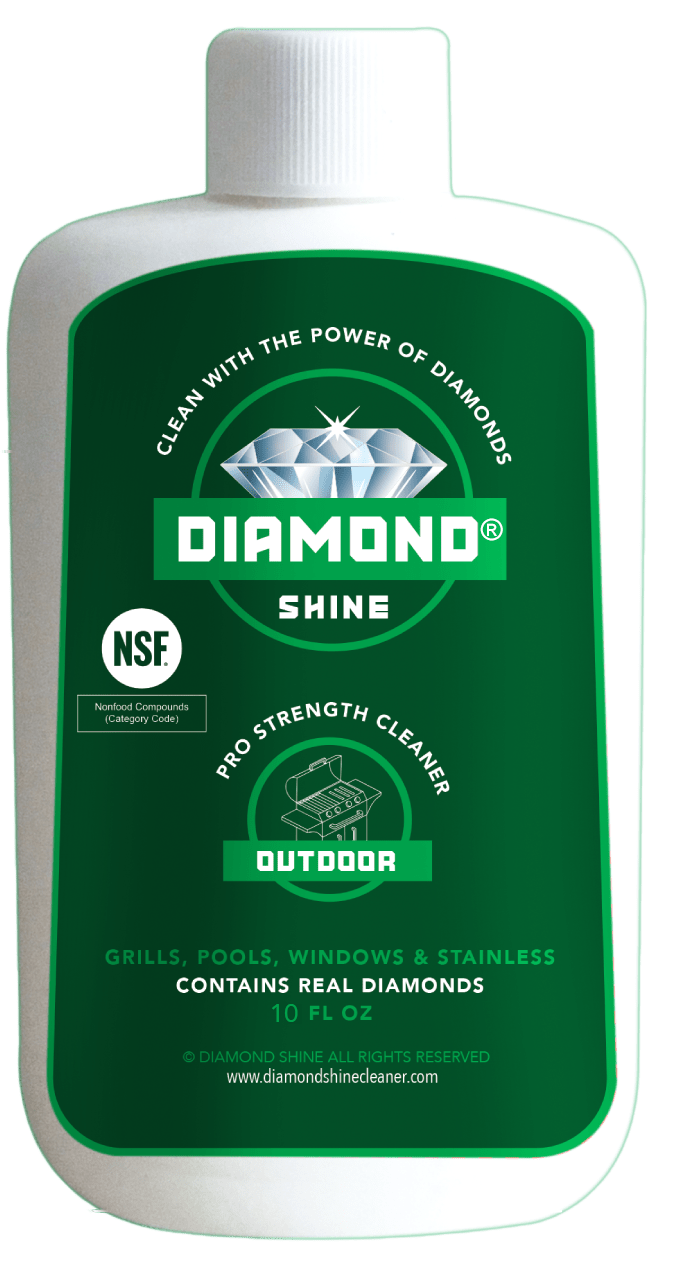
Those last two categories are where a general-purpose cleaner stalls out. Diamond Shine BBQ Grill & Outdoor Cleaner is made for that job on outdoor surfaces including brick, stucco and cement — use it to spot-treat rust rings and mineral bloom rather than to wash a whole slab.
Why a drill brush beats a deck brush
A long-handled deck brush gives you maybe sixty strokes a minute, and the pressure drops off as your shoulders tire. A brush head in a cordless drill spins continuously at a speed your arms cannot match, keeping the bristle tips working at a consistent angle into the pore structure. On porous surfaces, that consistency is the whole game.
Two details matter more than horsepower. Use a set with an extension rod so you can stand mostly upright instead of crouching for an hour. And use low drill speed to spread the cleaner, then medium for the actual scrubbing — full speed mostly throws product off the surface.
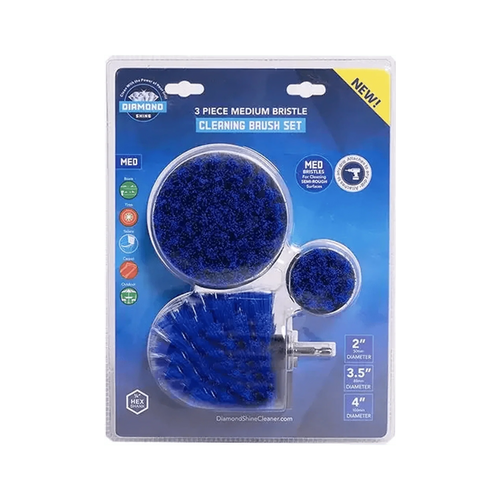
The 5-piece hard bristle drill brush set covers the shapes a patio needs: flat brushes for open slab, a cone brush for mortar joints, and the 6-inch extension for reach.
Match the bristle to what you are standing on
Bare broom-finish concrete, brick, block and paver joints take a hard bristle without trouble. Sealed, stamped, colored or polished concrete does not — a stiff brush dulls sealer and scuffs pigment, and that damage does not wash out.
Not sure which you have? Flick water on a dry patch. If it beads or sits in a film, there is sealer on it; use a soft bristle set and start gently. Either way, test an out-of-sight corner first.
The order of operations
Sequence matters more than product volume. Sweep the surface dry first — scrubbing loose grit just grinds it around. Then rinse, and let the area come back to damp rather than flooded before you apply anything, so the cleaner is not instantly diluted.
Work in sections of roughly three feet by three feet. Apply cleaner, give it the dwell time on the label, then agitate and rinse that section before the product dries on the surface. Letting it dry is what leaves streaks and hazy patches, and it is the one thing most of these labels warn about explicitly.
Finish the edges by hand. Drill brushes are excellent on open area and genuinely bad at the last inch against a wall or step riser. A crevice brush set handles step corners, expansion joints and the strip along the foundation.
Do it before the first hard freeze
There is a reason to get to this in autumn rather than next April. Porous masonry holds water, and water expands when it freezes. A slab that goes into winter packed with organic debris and clogged pores holds more moisture for longer, through every freeze and thaw. Clearing the surface and the joints while the weather is mild is a small job; dealing with a winter's worth of trapped grime is not.
Two last cautions. Never combine cleaning products to make them stronger — acids and bleach together produce chlorine gas, on a patio as easily as in a bathroom. And ease off the pressure washer on older concrete and mortar; a wide fan tip at moderate pressure cleans fine, while a narrow tip at full pressure will etch the surface and blow out joint material you then have to repair.
Clean concrete is not a matter of scrubbing harder. It is a matter of knowing which of three deposits you are looking at, giving the right product time to work, and agitating hard enough to reach the pores.